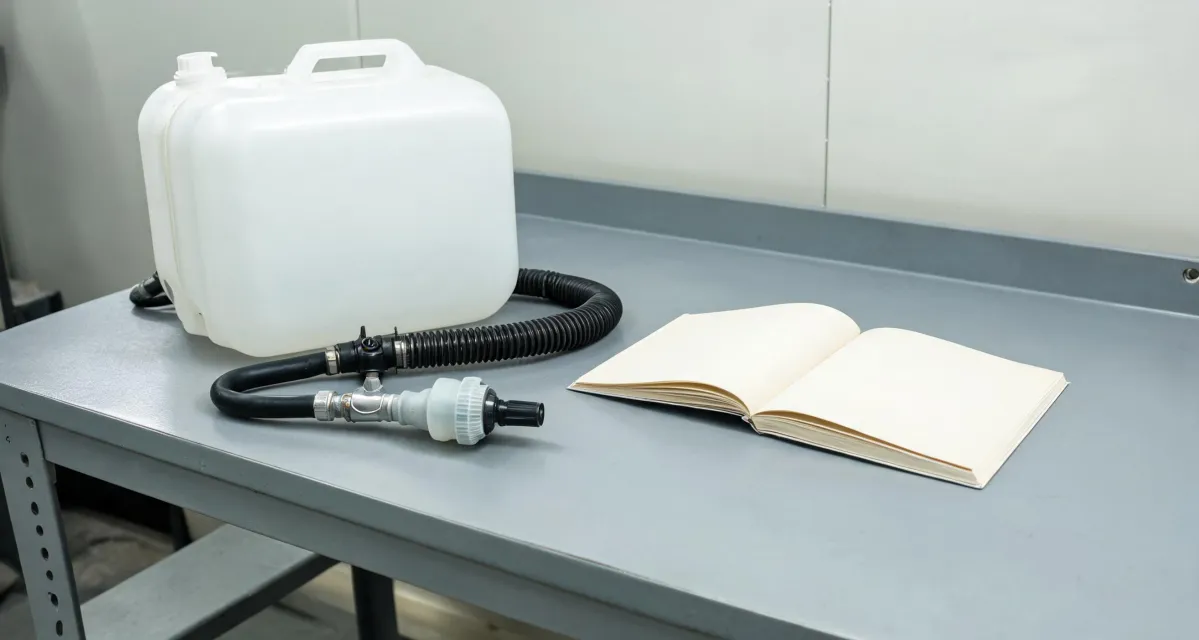
Can you really read the tank level on the ECHO MB-5810 and keep the pack comfortable on your back? You can, under two conditions: the semi-transparent tank shows a clear line in the light you actually work in, and the backpack pad and forward-tilt frame sit against your torso the way the design assumes. Both are features of this model as ECHO describes them, and neither comes with a measured fatigue figure attached.
What follows is a check order you can run in one dealer visit and then repeat on your own schedule, from the first fit to a month of real work. The point is to turn level visibility and harness fit from brochure language into things you have personally confirmed or personally rejected. Every check below applies to the MB-5810 as described by the manufacturer, and none of it carries over to other tanks, other frames, or other mist blowers.
What to Check First on a New MB-5810
The order runs from tank view to harness and frame fit, then to first fill readability, then to end-of-job balance, and repeats at one week and one month. Sequence matters because each check narrows what you look for in the next. If the level line is invisible from where you actually stand, no amount of pad adjustment rescues the setup.
Start with the tank. ECHO fits the MB-5810 with a semi-transparent tank that allows easy monitoring of liquid levels, which is a claim about being able to see the level, not about how accurate your mix is or how the tank behaves near empty. Stand where you will stand while spraying, look down at the tank in the light you will actually have, and decide whether you can read the level without leaning the pack forward or taking it off. Needing to tilt it to see is a real cost on a stop-and-go job.
Then the frame. The forward-tilt backpack frame is described as providing optimal balance while working and reducing stress on the operator's back and shoulders, and the pad is described as comfortable. Treat all of that as design intent you are testing against your own body: the load should sit over your hips and mid-back, and the tilt should feel like it is holding you upright rather than pulling you forward or pushing you back. A check that is done right looks uneventful. You stand still with your hands off the straps and nothing slides.
One caution about this walk-through: it is a buyer's sequence, not a manufacturer-mandated inspection. ECHO's description of the MB-5810 sets no interval, no threshold, and no pass or fail line. You are deciding whether the setup suits you, and that call stays with you.
Fitting the Pad and Forward Tilt on Day One
Day one is about strap length and contact points, not about adding padding. The manufacturer describes a comfortable backpack pad and a forward-tilt design on this model; it does not publish strap settings, so follow the fitting guidance that ships with the unit and change one strap at a time so you can feel what each change did.
A soft pad is not the same as a good fit. The pad only helps where it contacts your back, and where it contacts your back depends on how high the frame rides and how tight the shoulder straps are. Set the pack so the widest part of the pad crosses your mid-back, snug the shoulder straps until the load stops shifting when you twist, and check the waist belt afterward — a belt cinched first tends to drag the frame down and sit the pad too low.
The forward tilt is the part most buyers misread. ECHO states the forward tilt backpack frame provides optimal balance while working, reducing stress on the operator's back and shoulders. That is a balance claim. It tells you the frame is angled so the tank's weight sits closer to your center of gravity as you walk and lean into a spray pass. It says nothing about whether that angle matches your torso length, and it gives no figure for how much stress is relieved.
Load the pack the way you intend to run it, then walk a few passes before you plan a full day behind it. That is the check that matters. If the frame pulls you forward on flat ground, a longer strap will not fix it, and you have learned something useful while the machine is still in the yard.
At First Fill, Is the Tank Level Readable?
First fill is where the semi-transparent tank either earns its place on your shortlist or loses it. Fill to a level you will commonly run, get the pack onto your back, and look at the tank from the position you spray from. Do it in shade and again in direct sun if the dealer will let you, because a translucent wall reads very differently against a bright sky than against a dark hedge row.
What you want is a visible line without extra motion. If confirming the fill means unbuckling a strap or angling the tank toward the sky, you will skip the check on busy mornings — and that is exactly when running low matters. Better to learn that at the dealer than halfway down a row.
Residue is the part the wording leaves open. The tank wall is described as it behaves when clean, and a coating of residue on the inside cuts what you can see. ECHO's description of the MB-5810 gives no cleaning schedule and no promise of equal readability across mixes, so the practical move is to look at the tank after a job and judge whether the leftover film still leaves the level line readable. If it does not, that is a routine you want solved before the season, not during it.
After One Week, Does Backpack Comfort Hold Up?
One week of real work is long enough to see whether the pad and frame are doing their job, and the signals are behavioral rather than numerical. You stop hitching the pack up between passes. You turn to look behind you without the frame swinging around. Your shoulders do not carry the pressure points they carried on day one.
Judge after a full job, not after a one-minute pickup. Suppose a grower spends a morning doing stop-and-go spraying along a fence line: engine on, engine off, short walks, a lean into each spray pass. That pattern loads the shoulders and the frame differently than one long walk, and a pack that feels fine standing still can feel wrong by the third hour. What you are testing is whether the balance the forward-tilt frame is designed for still feels balanced when you are tired and moving unevenly.
If the pack needs constant re-seating, suspect the fit rather than the pad. Padding cannot rescue a frame that sits too high or straps that are too loose; it only softens the contact point. Go back to strap length and pad height before you conclude the design does not suit you, and if it still will not settle, that is your answer.
One Month In, Which Checks Become Routine?
By one month, three checks should happen without thinking. Read the level from the carrying position before each fill, check the pad and straps as you put the pack on, and confirm the balance at the end of each job. Everything else can stay deliberate for a while longer, including how the pack felt on a long day compared with a short one and whether the tilt suits the ground you actually work.
What stays deliberate is anything the manufacturer has not specified. ECHO's description of the MB-5810 gives no maintenance interval, no replacement life for the pad or straps, and no cleaning schedule, and guessing at those is worse than looking them up. Put the questions to the model-specific manual and to the dealer before the first season closes, so the answers exist before something gives out in the middle of a job.
Where the Comfort Wording Stops
Comfortable, optimal balance, reducing stress — those are design statements about the MB-5810, exactly as strong as they sound and no stronger. They come with no measured fatigue reduction, no comparison against another pack, and no fit guarantee for your body. A buyer who reads them as a promise will be disappointed by a harness that was never set up for their torso. A buyer who reads them as design intent has something concrete to check.
The same caution applies to the tank. Readable liquid levels are a claim about how the tank wall is built, not about every mix, every lighting condition, or every fill level. And the fan and housing design that ECHO describes as improving chemical flow is a separate feature that says nothing about level visibility or harness comfort, so a good impression of one part of the machine should not be allowed to carry the other parts.
Who Should Not Buy This Backpack Setup
If you cannot put the pack on before you buy, or cannot look at the tank in your normal working light, this setup is not for you. Both features being checked here are confirmed with your own eyes and your own back, and a spec sheet cannot do that work. The same goes for a buyer who needs a published fatigue figure or a head-to-head test before committing — the MB-5810 description does not provide either, and no amount of reading will produce them.
It is a reasonable candidate for a grower who can stand in the dealer's yard with the pack fitted, read the level line from the carrying position in ordinary daylight, and walk a few passes to feel whether the forward tilt matches their torso. If those three checks come out clean, the semi-transparent tank and the forward-tilt frame are doing the job they were described as doing. If any one of them fails, the answer is a different pack, not a different strap setting.

Leave a purchasing question
Comments are for discussion. Use the procurement inquiry for business contact details and supplier matching requests.