-
Start Your MB-5810 Checks With Three Design Facts
-
Chemical Flow Comes Down to Fan and Housing
-
A Tank You Can See Through Is a Mixing Tool
-
Forward Tilt Decides Whether You Finish the Row
-
Match the Machine to the Job First
-
Dealer Questions the Spec Sheet Cannot Answer
-
What the Manufacturer Description Leaves Out
The ECHO MB-5810 product page could have led with spray output, and what it actually puts in front of you is a semi-transparent tank, a fan-and-housing arrangement, and a backpack frame built with a forward tilt. No airflow figure, no droplet size, no coverage claim. That omission reorders the buyer's checklist, because the only claims you can check before the machine is standing in your rows are design claims.
Everything here applies to the ECHO MB-5810 liquid mist blower as its maker describes it, and to nothing else in the category. The case is deliberately narrow: three described design facts, the air path, the visible tank and the tilted frame, make a better purchase check than a headline spray number, since they are the only things a buyer can confirm before money changes hands. What follows can tighten your job fit and sharpen your questions. It cannot tell you how this machine sprays, and it will not pretend to.
Start Your MB-5810 Checks With Three Design Facts
ECHO presents the MB-5810 as a professional mist blower for maintenance and care of fruit, vegetables, trees and all types of treatments. Read that as a scope statement from the manufacturer rather than a trial result: it tells you which family of work the machine is aimed at, and it tells you nothing about how well it does that work on your block.
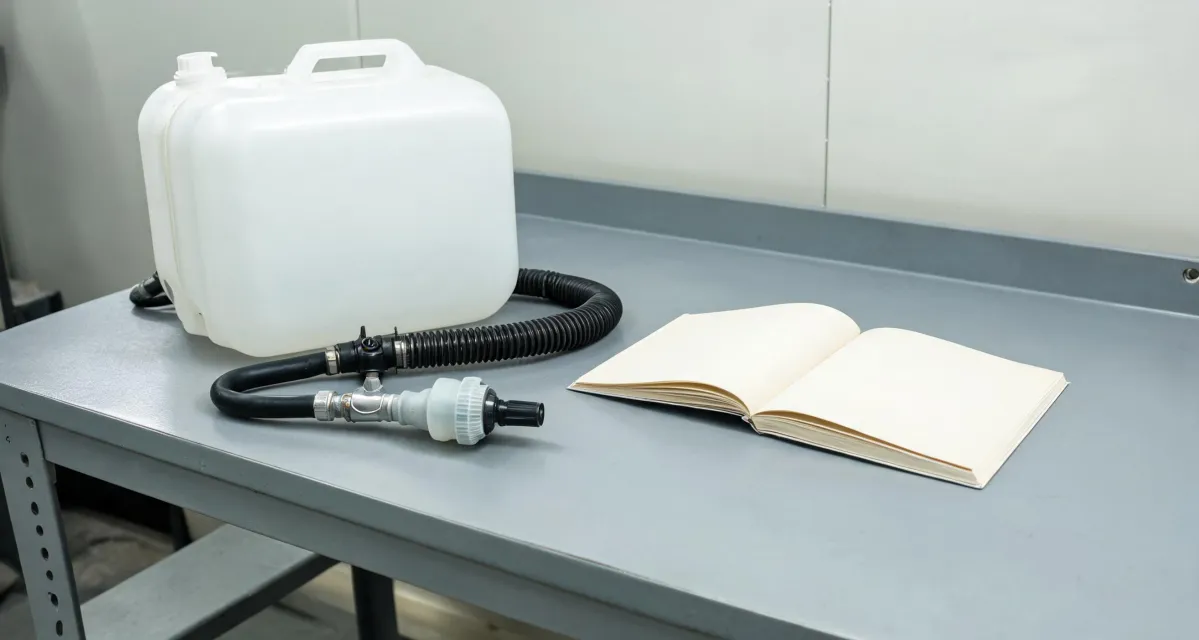
The same description commits to three things. A fan and housing design intended to improve the flow of chemicals. A semi-transparent tank that lets you monitor liquid levels without guesswork. A forward-tilt backpack frame that provides balance while working and reduces stress on the operator's back and shoulders. Grouping those three into a single checklist is my reading, not a claim ECHO makes, and the grouping holds up because each one maps to a separate decision you make on every pass.
The air path decides how the mixture leaves the machine. Tank visibility decides when you stop and walk back to the mix station. Frame geometry decides how long you keep going before you want the pack off your back. Three questions, three answers you can get on a dealer floor or with a loaded pack in the yard, and none of them needs a performance figure to be useful.
Comparing published figures across models fails for a boring reason: a number you cannot check against your own canopy just relocates the guess to somewhere after the invoice, where it costs more to fix.
Chemical Flow Comes Down to Fan and Housing
Droplets do not travel on their own. They ride the air the machine pushes out, and the fan and housing is the part that shapes that air before it leaves. Which means the flow path, not the pump's push, is what sets how the mixture exits the machine and how it holds together on the way to the canopy.
That changes what you ask at the counter. Instead of asking how hard it sprays, ask what the air path does at the setting you will actually run, whether the stream stays together at the distance you spray from, and what happens to it when you throttle down beside a young block.
There is a trade inside that air path worth naming. The same stream that carries mixture into a canopy will carry it past the canopy if the wand is pointed wrong or you stand too far back, because the droplets have no other means of travel. That is not a flaw of this model; it comes down to what an air-carried spray is. Your control over it is setting and distance, which is why asking how the path behaves at your setting beats asking for a bigger number.
In the material reviewed here, no airflow, velocity, droplet-size or coverage figures appear for this model. The reason that matters is practical rather than pedantic: without them you cannot honestly compare this machine to another on paper, so those items become questions with a blank answer sheet instead of assumptions you quietly fill in. ECHO's own wording is directional, that the design is meant to improve the flow of chemicals. Improved relative to what, and by how much inside a canopy of your density, is not stated, so treat the phrase as intent.
A Tank You Can See Through Is a Mixing Tool
On a backpack sprayer the tank level is normally information you buy with a stop: set the pack down, unshoulder it, look. A semi-transparent tank that allows easy monitoring of liquid levels removes the stop. Why that is worth money is simple: the level becomes readable while the pack is still on your back, which means the refill decision moves out of the middle of a row and onto a block boundary you picked in advance.
Imagine a grower working a tree block where the last few rows are thinner than the first. With a level you can read in place, the pass can be split at a visible mark, say the half-tank line, so the walk back to the mix station happens at the edge of the block instead of wherever the machine happens to run dry. That scenario is hypothetical, offered only to show the kind of planning the feature makes possible, not to suggest a measured result.
There is a quieter second benefit. A level you can see is a check on the fill itself, so you know the tank went to the mark you intended before you lift it onto your shoulders. That is the difference between mixing to a known volume and mixing to a habit, and it shows up in how often a block gets a pass that is slightly richer or thinner than the last one.
Forward Tilt Decides Whether You Finish the Row
Anyone who has carried a loaded pack knows the weight hangs off the shoulders when it sits vertical behind you, so shoulder muscles and upper back do the holding and they tire first. The forward tilt on this frame is described as providing balance while working and reducing stress on the operator's back and shoulders, and the mechanics behind that are ordinary: tilt the pack forward and the carried mass settles closer over the hips, so the shoulders hold less.
Which means the effect you will actually notice is not comfort in the abstract but where your stop point falls. With the shoulders doing less holding, the moment in a pass when you first want the pack off arrives later, and fewer stops per block means less time unbuckling and more time with the wand where it is doing work.
No weights, tilt angles or endurance figures are published for this model, so do not take a number from me or from a forum thread. Load a pack at the dealer, wear it the way you would in the rows, and notice when you first want it off your shoulders. That is a short field check you can make yourself, and it tells you more about your working day than any figure somebody else quotes.
Match the Machine to the Job First
Before any of the three checks means anything, the machine has to be the right class of tool for the work. ECHO frames the MB-5810 around fruit, vegetables, trees and all types of treatments, a broad statement of intended use from the manufacturer, not an independent trial of how it performs in any one of those settings.
Translate that framing into your own facts while you are still shopping: what you treat, how tall and dense the canopy runs, how your rows are spaced, how often you walk the same block, and how far the mix station sits from the far corner. Fit fails at that level before it ever fails at the feature level, because a machine that is wrong for the shape of your rows cannot be rescued by a better fan or a larger tank.
Where that leaves me, when I am the one spending the money: give me a machine whose described design matches the rows I actually walk over one carrying a bigger published figure I have no way to check. The condition attached to that preference is not decoration. If your crop, row layout or treatment type fall outside the work the maker scopes this model for, the preference is void and the MB-5810 is simply the wrong class of machine, whatever its design does well.
Dealer Questions the Spec Sheet Cannot Answer
The public description leaves holes, and every hole is a question to ask before you sign anything. This material gives no airflow or droplet figures for this model, no list of compatible formulations, no parts and service picture, no coverage or throughput numbers, and no price. Each of those can be answered in one sentence at a counter, which is exactly why it should be answered before you pay rather than discovered mid-season with a block half finished.
Ask what the air path delivers at your working setting. Ask which formulations the maker's manual lists for this model and which it excludes. Ask what local parts stock looks like and how long a service turn takes when a machine goes down in the middle of a pass. Ask what throughput the dealer will stand behind for your canopy, in your rows, in writing. Ask for the price as you would actually buy it, with the accessories you need, not the bare unit on the shelf.
Then ask for two documents: the model's own owner's manual, and whatever local certification or paperwork applies where you farm. A written answer you can file is the substitute for the trial data this article cannot supply, and the reason to insist on paper is that a verbal yes is gone the moment the machine is in your shed and something does not match.
What the Manufacturer Description Leaves Out
A description tells you what a design is meant to do. It does not tell you what the machine delivers in your block, on your canopy, inside your mixing routine. The reason three design facts can order a checklist but cannot rank one machine against another is that ordering needs only what is described, while ranking needs what is measured, and nothing in this material is measured.
The honest output of the three checks is a shortlist and a set of answers on record, not a verdict on the MB-5810 and not a comparison against machines nobody here has watched run. No independent comparison, no price and no measured benefit sits behind these words. If a seller cannot answer the open gaps, the check fails on missing evidence about the machine, which is a different and more useful finding than a suspicion about it.
Which brings back the question that usually ends these conversations. If the page gives you no performance numbers, how do you justify the money? You justify it on fit and on record. Buy when the three described design facts suit your crop, your canopy and your rows, and when the dealer closes the open gaps in writing. If those gaps stay open, do not buy on a description, however well it reads. In that spot I would rather put the money against a machine whose design I can match to my own rows than against a figure nobody can show me standing in my orchard.

Leave a purchasing question
Comments are for discussion. Use the procurement inquiry for business contact details and supplier matching requests.