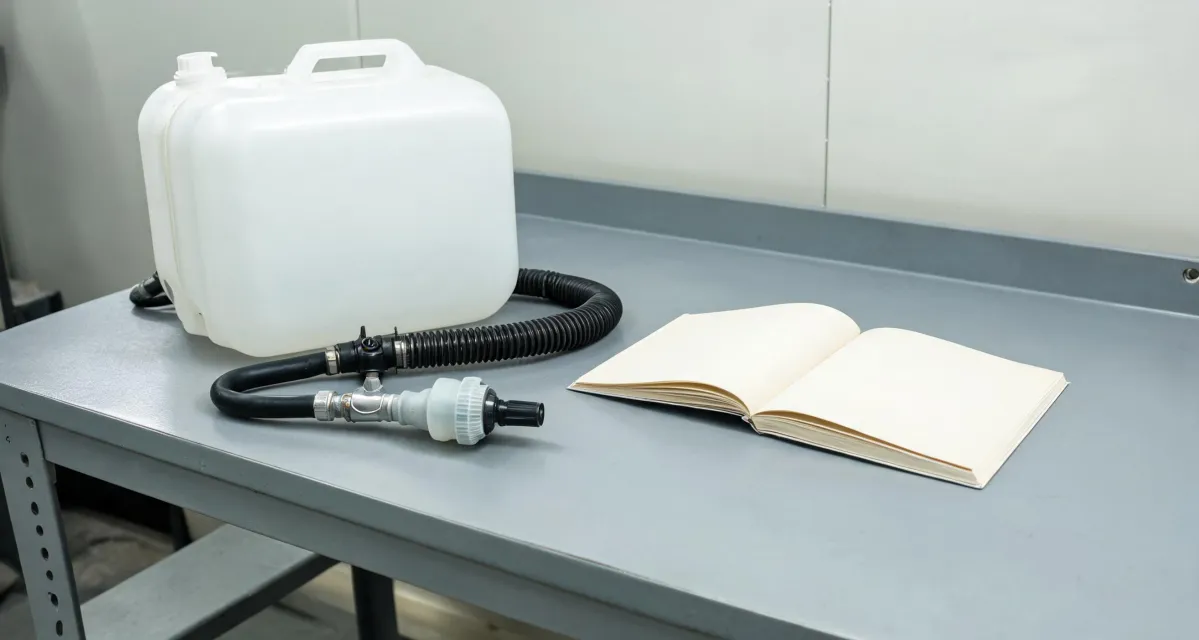
Imagine two rows in the same block, same mix in the tank, same ECHO MB-5810, one afternoon apart. On the first row the collar sat wherever the previous job had left it, and the result was easy to read: mist balled up on the near leaves until they ran, while the far side of the canopy stayed dry enough that you could see the difference from the headland. On the second row the step was chosen by the distance to the zone that actually needed treating, and the same load, out of the same tank, landed where it was supposed to.
That gap is the whole subject here. On the ECHO MB-5810 adjustable nozzle, the six-step collar is a reach control, not a rate control. Picking a step by how far the mist has to carry does more for coverage than picking it by how wet the leaves look. Everything below stays inside this one model; a different blower with a stepped collar does not inherit the conclusion.
Same Mix, Two Rows, Different Coverage
Only the collar position differed between those two rows: same load, same throttle, same hand on the trigger.
ECHO fits this blower with a special fan and housing design that the company describes as improving the flow of chemicals, and the collar on the same unit is the part ECHO credits with tuning spray distance. Put those two features side by side and the mechanism is not hard to reason about. The fan and housing decide how the airstream leaves the tube and how well it holds the mix together on the way out; the collar decides where along that airstream the working part of the plume is aimed to open up. Click the collar short and the dense part of the plume spends itself close to the head, so the near face of a canopy takes the load while the outer zone only gets the thin tail. Click it long and that working part travels further before it spreads, which is what puts mix on the far zone, with the inner canopy getting less of it than before. Two rows sprayed minutes apart with an identical mix can look like two different operators worked them, purely because the collar was left where the previous block put it.
Imagine a block with a near face thick with new shoots and a far zone that is the actual problem, the part where the canopy runs thin. Set the step for the near work and the far zone catches the tail of the plume and very little else. Set it for the far zone and the near face gives up some of what it had, which is a real trade, and it is the trade the collar exists to let you make on purpose instead of by accident.
What the Six-Step Nozzle Actually Adjusts
ECHO's own wording on the MB-5810 is short and worth taking literally: the 6-step nozzle allows fine tuning of spray distance. Distance is the variable named. Nothing on that page claims a change in output volume, droplet size or application rate, and nothing on it gives a per-step flow curve or a field dose figure.
That absence matters more than it looks. Once a collar has six clicks, the temptation is to read it like a rate dial, where a higher number means more chemical going out. There is no published basis for that reading on this model. The product description covers a fan and housing design intended to improve chemical flow, then it stops. If you need a flow figure for each step, or a droplet size for a given mix, that has to come from the manual, the dealer or the label, not from a guess dressed up as a setting.
What I Check Before the First Pass
Before the first pass of the day I check where the collar actually sits, because it is the one control on this machine that moves without announcing itself, and it is easily still on the number the previous block needed. I say the step out loud before the row starts so whoever takes the next one begins from the same place.
During the pass I watched the semi-transparent tank rather than the nozzle, and I noticed the level falling in a steady line rather than in surges. That steady fall is the visible sign that the machine is feeding the way it did on the row before. What I found harder is keeping track of which step I used on which block once the morning gets busy, and that detail is easy to lose between two blocks.
The Test I'd Run Before Trusting a Step
Suppose I wanted to know whether a step is really reaching the zone I picked it for, and I did not want to trust my eyes on a bright afternoon. The check I would run is a row-level one: same row, same mix, the collar position recorded for every pass, and something placed at the near face and out at the far zone that shows where the mist actually arrives. Water-sensitive cards would do it if I had any; marked dry surfaces at both depths would give a rougher read that is still useful.
The hypothesis is simple. A step chosen for the distance to the target zone should mark the far targets; a step left over from a nearer job should not. What would confirm it is the far targets marked and the near targets no wetter than they were on the previous pass. What would overturn it is far targets still dry with the collar set for that exact distance, and that result would say the collar is not the limiting factor for that block, which turns the question to the manual or the dealer rather than to another click upward.
A Higher Step Does Not Mean More Chemical
The instinct to click up a step when a row looks dry is understandable, and on this machine it is misdirected. The click changes where the mist is aimed to carry; it is not the control for how much leaves the tank.
Dry leaves at the far end of a row are not one problem, and the collar only answers part of it. If the mist never carried to that zone, the fix is reach, and reach is what the steps are for. If the mist arrives but the row still runs lean, the question has moved to liquid delivered across the row, and no collar position settles it; that belongs to the label, the manual or the dealer. Reading every dry row as a call for more and clicking up conflates the two questions, and the next pass on that block starts from a setting nobody can explain.
Where a Distance Setting Stops Helping
The reach setting has limits, and they are worth naming before the season starts. ECHO describes the MB-5810 as a professional mist blower for maintenance and care of fruit, vegetables, trees and all types of treatments, which is a statement about this model and its intended work, not a promise that any given block sits inside its range.
Three conditions would make a distance setting the wrong answer no matter which step you choose. A target zone the airstream cannot carry to at the longest step is one, and the fix there is a different machine or a different approach, not a different click. A job where the deciding variable is delivery rate rather than reach is another, and that is precisely the question the unpublished flow curve would answer. A machine that is not this model is the third, since none of this transfers. Where any of those apply, the useful move is a precise question to the dealer or the manual, what is the output at each of the six positions for this mix, rather than a guess that looks like a setting.
Before the next tank, walk to the first row and set the collar by the distance to the zone you mean to treat, not by where it stopped last time. Then read the row from the end before you move on: is the far zone taking mist, and is the near side wetter or drier than it was on the pass before. Watch the tank level as the row runs, so you know the feed held steady from the first tree to the last. If a block needs a delivery rate you cannot confirm for this machine, ask for it rather than guess a step and hope the row repeats itself.

Leave a purchasing question
Comments are for discussion. Use the procurement inquiry for business contact details and supplier matching requests.